AI Fashion Images: Can You Legally Sell & Use Them?
Prateek Gupte
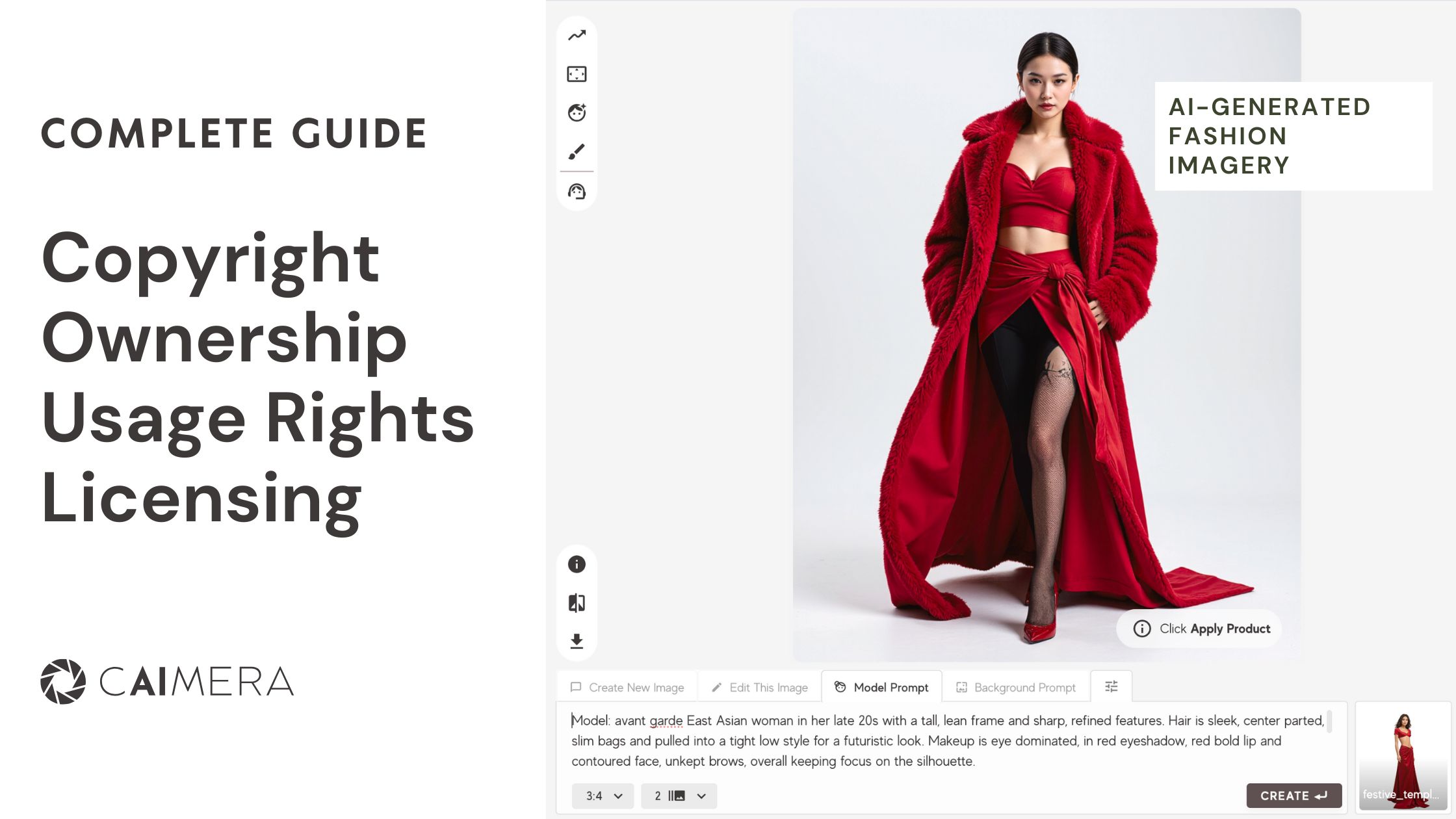
The fashion industry is experiencing a revolution with AI-generated imagery. From runway presentations to advertising campaigns, artificial intelligence tools are creating stunning visuals that challenge our understanding of photography, art, and ownership. But this exciting technology brings important questions about copyright, licensing, and ethical use.
This guide answers the most pressing questions fashion professionals, brands, and creators face when working with AI-generated images.
Copyright and Ownership
Who owns the copyright of AI-generated images?
Copyright ownership of AI-generated images remains one of the most debated topics in creative law. The answer depends on where you are and how the image was created.
In the United States, copyright law currently states that only works created by humans can receive copyright protection. The U.S. Copyright Office has rejected several applications for AI-generated works, stating that copyright requires human authorship. This means a purely AI-generated image, created without significant human creative input, cannot be copyrighted in the U.S.
However, if you use AI as a tool while providing substantial creative direction, prompts, editing, and selection, you may have a stronger claim to copyright. Think of it like using Photoshop. The software does not own your edited photo because you made the creative decisions.
In Europe, the situation varies by country. The European Union is developing frameworks to address AI creativity, but current laws still emphasize human authorship. Some countries like the UK have provisions that assign copyright to the person who made arrangements for the creation of computer-generated works.
For fashion brands, this creates uncertainty. If you commission AI-generated product photos or campaign imagery, clarifying ownership in contracts becomes essential. The person who crafted the prompts, selected the outputs, and directed the creative process may have the strongest ownership claim.
Can AI itself hold copyright?
No. The landmark case Creativity Machine v. US Copyright Office settled this question definitively. Dr. Stephen Thaler attempted to register copyright for an AI-generated artwork called “A Recent Entrance to Paradise,” listing his AI system as the author. The U.S. Copyright Office rejected the application, and federal courts upheld this decision in 2022 and 2023. The ruling confirmed that copyright law requires human authorship. AI systems cannot be authors or copyright owners under current U.S. law, regardless of how sophisticated they become.
What are the legal precedents for AI image ownership?
Legal precedents are still emerging because AI image generation is relatively new. Several important cases are shaping how courts view AI-created content.
Getty Images v. Stability AI (2023-2025) represents one of the most significant cases for the fashion industry. Getty Images sued Stability AI, claiming the company used over 12 million copyrighted images from Getty’s collection to train Stable Diffusion without permission or licensing. Getty also alleged trademark violations because some AI-generated images included distorted Getty watermarks. In September 2024, a UK judge ruled in favor of Stability AI on the trademark claims, finding that watermark reproduction did not constitute trademark infringement. However, this case highlighted the tension between AI companies and content creators. For fashion photographers whose work appears in stock libraries, this case raises concerns about whether their images might train AI systems without consent or compensation.
Andersen v. Stability AI (2023-2024) brought together artists including cartoonist Sarah Andersen in a class action lawsuit against Stability AI, Midjourney, DeviantArt, and Runway AI. The artists claimed these companies scraped billions of copyrighted images from the internet to train their AI models without permission. In July 2023, the judge dismissed most claims but allowed copyright infringement and trade dress claims to proceed. The case remains in active litigation. For fashion illustrators and designers, this case directly addresses whether AI training on copyrighted artistic works constitutes infringement.
Disney & Universal v. Midjourney (2025) escalated AI copyright concerns to a new level. Disney and Universal filed federal litigation against Midjourney, alleging massive copyright infringement through unauthorized reproduction of their characters, designs, and distinctive styles. The complaint described Midjourney as a “bottomless pit of plagiarism.” This case matters enormously for fashion merchandising, where character licensing generates billions in revenue. If AI tools can generate images of copyrighted characters on clothing and accessories, it threatens established licensing models. The case remains ongoing and could establish crucial precedents for protecting distinctive design elements.
Visual Artists v. Google (2024-2025) targets Google’s Imagen AI system. Artists filed a federal class action lawsuit claiming Google trained Imagen on copyrighted artworks without authorization. The case challenges whether Google’s use constitutes fair use or copyright infringement. For fashion illustration and design, this case could determine whether tech companies can freely use copyrighted creative works to train commercial AI systems.
Rosae Paris v. Seven August (2025) is testing EU fashion design protection in the AI era. French fashion brand Rosae Paris sued competitor Seven August for allegedly copying designs using AI technology. The case examines originality standards for applied art under the EU InfoSoc Directive. European courts are reviewing whether AI-generated fashion designs meet originality requirements and how to prove design copying when AI tools are involved. This case could establish important precedents for fashion design protection in Europe.
For fashion professionals, these cases highlight critical issues: whether AI training on copyrighted material constitutes infringement, how to prove copying when AI is involved, and whether distinctive styles and characters receive protection against AI reproduction.
What copyright challenges exist for AI-generated art?
How does proving human authorship work? When you generate an image using simple prompts like “red evening gown on runway,” courts may view this as insufficient creative input for copyright protection. The more detailed your prompts, selections, and post-generation editing, the stronger your copyright claim becomes.
What about training data? Most AI image generators learned by analyzing millions of existing images, many copyrighted. The Andersen v. Stability AI case specifically challenges this practice. If an AI tool produces an image closely resembling a copyrighted photograph or design, questions arise about infringement. Fashion brands must consider whether AI-generated images might accidentally copy protected designs.
Who gets credited? Traditional photography credits the photographer. But who gets credited for an AI image? The prompt writer? The AI tool? The company that made the AI? Fashion publications and brands are still developing standards.
Do international differences matter? Absolutely. A fashion brand operating globally cannot assume one country’s copyright rules apply everywhere. An image receiving protection in one jurisdiction might be considered public domain in another. The Rosae Paris case in the EU demonstrates how different regions approach these questions.
What originality requirements apply to copyright protection?
Copyright law protects original works of authorship. For AI-generated fashion images, meeting originality requirements presents unique challenges.
Originality has two components: independent creation and minimal creativity. Independent creation means you did not copy from someone else. Minimal creativity means the work shows at least a small amount of creative choice.
With AI-generated images, independent creation becomes questionable when the AI trained on copyrighted works. If your AI-generated evening gown design resembles a copyrighted Versace dress because the AI learned from Versace images, you may face challenges proving independent creation. This is exactly what the Disney v. Midjourney case addresses regarding character designs.
How much creativity is enough? Writing “fashion model” as a prompt shows minimal creativity. Writing a detailed prompt specifying pose, lighting, fabric texture, color palette, mood, and styling shows substantial creativity. Post-generation editing strengthens originality claims significantly.
Does selection count as creativity? Yes. Professional photographers often take hundreds of shots and select the best ones. Similarly, generating multiple AI images and curating the best results demonstrates creative judgment. The selection process itself can show creativity.
For fashion brands, documenting your creative process helps prove originality. Save your prompts, keep records of iterations, and document editing decisions. This evidence supports copyright claims if disputes arise.
Licensing and Usage Rights
Can you use AI-generated images commercially?
Commercial use depends on the specific AI tool’s terms of service and the legal questions surrounding AI outputs.
What do major platforms allow? Midjourney permits commercial use for paid subscribers, but free trial users face restrictions. DALL-E from OpenAI grants users full rights to use, sell, and commercialize images they generate. Stable Diffusion, being open source, generally allows commercial use without restrictions.
What are the risks? Since AI-generated images may not receive copyright protection, you cannot prevent others from using identical or similar images. If a competitor generates a similar fashion campaign image using the same AI tool, you cannot claim infringement.
Should fashion brands worry about exclusivity? Yes. Unlike hiring a photographer who grants you exclusive rights to unique photos, AI-generated images may be replicated by others. This matters for brand identity and marketing campaigns where uniqueness drives value. Some brands use AI-generated images as starting points, then modify them significantly through human editing to create truly unique final images.
What attribution requirements exist for AI photos?
Is attribution legally required? Currently, no universal law requires attributing AI-generated images. However, disclosure practices are emerging as industry standards. Many fashion publications now tag AI-generated images to maintain editorial integrity and reader trust.
Do platforms require it? Some AI platforms include attribution requirements in their terms of service. Adobe Firefly encourages users to indicate when images are AI-generated, particularly for commercial use. Social media platforms like Instagram, Facebook, and TikTok now require disclosure of realistic AI-generated content.
What are best practices? Use simple labels like “AI-generated image,” “Created with [AI tool name],” or “AI-assisted photography.” For fashion brands, transparency builds trust with consumers who increasingly value authenticity.
Why does it matter ethically? When consumers see a fashion campaign image, they may assume it involved a photographer, models, stylists, and a production team. Using AI-generated imagery without disclosure could be seen as misleading and may violate false advertising laws.
How do Creative Commons licenses work with AI art?
Creative Commons licenses provide standardized ways to grant permissions for creative works. However, applying these licenses to AI-generated fashion images presents complications.
Can you apply Creative Commons to AI images? Creative Commons licenses assume the person applying the license owns copyright in the work. Since AI-generated content may not receive copyright protection, applying a Creative Commons license to purely AI-generated images creates legal ambiguity. You cannot license rights you do not own.
When does it work? If you create a work combining AI-generated elements with sufficient human creativity to qualify for copyright, you could apply a Creative Commons license to the entire work. For example, a fashion editorial layout combining AI-generated garment images with human-written text, human-designed layout, and human curation could receive a Creative Commons license.
What about CC0? The CC0 license, which places works in the public domain, makes sense for AI-generated content that may already lack copyright protection.
Where can you license AI-generated fashion images?
Several platforms now facilitate licensing of AI-generated fashion imagery, though the market is still developing.
Adobe Stock began accepting AI-generated images in 2023 with strict requirements. Submitters must disclose that images are AI-generated, ensure they have rights to commercialize them, and verify the images do not infringe on copyrights or rights of publicity.
Shutterstock partnered with OpenAI and offers AI-generated images through its platform. The company developed a Contributor Fund to compensate artists whose work was used to train the AI, addressing ethical concerns highlighted in cases like Andersen v. Stability AI.
Getty Images launched its own AI generator in partnership with NVIDIA, creating a platform where all outputs can be commercially licensed. Getty ensures the AI was trained only on licensed content, reducing legal risks. This approach directly responds to concerns raised in their lawsuit against Stability AI.
Specialized platforms like Freepik have integrated AI image generation directly into their stock image services. Users can generate custom fashion imagery and immediately license it for commercial use.
Legal Considerations and Risks
What infringement risks exist with AI-generated content?
Training data infringement represents the primary risk. The ongoing lawsuits against Stability AI, Midjourney, and Google’s Imagen specifically challenge whether training AI on copyrighted images without permission infringes copyright. If courts rule that it does, AI tools trained on such data and their outputs could expose users to liability.
Style mimicry creates another risk. AI tools can generate images “in the style of” specific photographers or artists. If you prompt an AI to create fashion images matching a famous photographer’s distinctive style, the resulting images might infringe copyrights or trademark rights.
Rights of publicity violations occur when AI-generated images closely resemble real people without consent. Fashion brands cannot use AI to create realistic images of celebrities or models wearing their products without permission. The Disney v. Midjourney case demonstrates how protective companies are of their character likenesses.
Design infringement happens when AI-generated fashion items too closely resemble copyrighted or trademarked designs. The Shein class action lawsuits (2023-2025) allege systematic reproduction of designer works via AI. Multiple designers and artists sued Shein for using AI to copy their designs without permission. These cases are currently in mediation but highlight the risk of using AI to replicate existing fashion designs.
What are the legal implications of deepfakes in fashion?
Rights of publicity protect individuals from unauthorized commercial use of their identity and likeness. Creating an AI-generated image of a celebrity wearing your fashion brand without permission violates these rights. The celebrity could sue for damages and demand you stop using the image.
What laws specifically address deepfakes? Many jurisdictions have strengthened laws against deepfakes. California prohibits using a person’s likeness in deepfakes without permission, particularly for commercial purposes. Texas, Virginia, and other states have similar laws. Fashion brands operating nationally must comply with the strictest state laws.
What is false endorsement? False endorsement claims arise when consumers might reasonably believe a person endorsed a product they did not actually endorse. An AI-generated image showing a celebrity wearing your fashion brand creates this impression and could constitute false advertising or unfair competition.
Are there legitimate uses? Yes. With proper consent and disclosure, fashion brands can use AI to create virtual models or alter existing photos, provided contracts allow this and consumers understand what they are viewing.
What ethical considerations apply to AI image generation?
Why does transparency matter? Fashion consumers increasingly value knowing what they are buying and how it was created. Using AI-generated models, products, or scenes without disclosure feels deceptive, even when legal. Ethical brands disclose AI use clearly.
What about labor impacts? Fashion photography supports entire ecosystems of photographers, models, stylists, makeup artists, and production crews. The Shein cases illustrate how AI can systematically replace human creative labor. Ethical approaches balance AI efficiency with supporting creative professionals.
How does bias affect AI imagery? AI models trained primarily on images of certain demographics may perpetuate bias, generating fashion imagery that lacks diversity. Ethical brands ensure their AI-generated imagery represents diverse body types, skin tones, ages, and abilities.
Do artists’ rights matter? Yes. The Andersen v. Stability AI and Visual Artists v. Google cases raise fundamental questions about fairness. Using AI trained on copyrighted works without compensating original creators raises ethical concerns even if courts ultimately rule it legal. Some fashion brands choose AI tools that compensate artists whose work contributed to training data.
Disclosure has moved from ethics into law. See our guide to the AI image disclosure laws taking effect across New York, the EU, and California in 2026.
How does data privacy relate to AI image creation?
What privacy laws apply? The European Union’s General Data Protection Regulation treats images of identifiable people as personal data requiring consent for processing. AI companies training models on such images must comply with GDPR. Fashion brands in Europe using AI-generated imagery should verify their AI providers comply with data protection laws.
What about biometric data? Biometric data protection applies when AI analyzes facial features or body measurements to generate realistic people. Some jurisdictions classify biometric data as sensitive, requiring extra protection.
Do platforms collect user data? Yes. When you upload reference images or use AI tools, platforms may collect and store your data. Fashion designers creating proprietary designs with AI should review privacy policies to understand who can access their creations.
What about model releases? Traditional fashion photography requires models to sign releases granting rights to use their images. With AI-generated models, no real person exists to grant consent, potentially simplifying privacy concerns. However, if AI generates images closely resembling real people, those individuals might claim privacy violations.
Fair Use and Public Domain
Does fair use apply to AI-generated images?
Fair use allows limited use of copyrighted material without permission for purposes like criticism, commentary, news reporting, teaching, or research.
Can AI training claim fair use? AI companies argue training on copyrighted images constitutes transformative fair use. They claim the AI learns abstract concepts rather than copying specific images. This argument is central to the Andersen v. Stability AI, Getty Images v. Stability AI, and Visual Artists v. Google cases. Courts have not yet definitively ruled on whether AI training qualifies as fair use.
When might your use be fair use? Using an AI-generated image of a designer dress to discuss AI in fashion design might qualify as fair use. Using it to sell competing products would not. The transformative nature of your use matters significantly.
Is fair use reliable? No. Fair use is a defense to infringement, meaning you might still face lawsuits even if you ultimately prevail. Fashion brands preferring certainty should obtain proper licenses rather than relying on fair use.
Are AI-generated images in the public domain?
What does U.S. law say? In the United States, works without human authorship cannot receive copyright protection, which typically means they enter the public domain immediately. The Creativity Machine case confirmed this principle. Purely AI-generated fashion images with no human creative input would be public domain from creation.
Does this mean free use? Not necessarily. The AI tool’s terms of service may impose contractual restrictions even if copyright does not exist. These are contract terms, not copyright restrictions.
What about images with human input? Images with substantial human creative input might receive copyright protection and would not be public domain. A fashion designer who writes detailed prompts, generates hundreds of variations, carefully selects outputs, and significantly edits them adds enough human authorship for copyright protection in many cases.
Do international differences matter? Yes. Some countries have different originality thresholds. An image considered public domain in the U.S. might have copyright protection in the UK or Europe, as the Rosae Paris case in the EU demonstrates.
What constitutes transformative use in AI art?
What is transformative use? Transformative use creates something new with different purpose or character from the original.
How do AI companies claim transformation? When AI companies train models on copyrighted images, they argue the training process is transformative. Rather than reproducing specific images, the AI learns patterns across millions of images to generate entirely new works. The Andersen, Getty, and Google cases will determine whether courts accept this argument.
How can fashion brands transform AI outputs? Taking AI outputs and substantially modifying them creates transformative use. Compositing multiple AI images with original photography, adding illustrations, and creating entirely new context demonstrates substantial transformation. Simply adjusting colors or cropping likely does not.
Generative AI Tools and Policies
What do terms of service for AI image generators say?
Caimera: An AI-powered photography platform that generates realistic imagery for fashion brands with virtual models. Brands can create studio-quality product shots for editorial content, marketing campaigns and advertisements by simply uploading garment or product images and customizing models, backgrounds, and lighting.
Midjourney: Grants paid subscribers significant rights to generated images, including commercial use, but retains some licenses to your creations. Free trial users receive more limited rights. Midjourney does not claim your prompts belong to them, but they can use your generated images in certain ways. Fashion brands should subscribe to paid plans for commercial projects.
DALL-E: OpenAI provides users with full ownership rights to images created, including commercial use, selling, and reproduction rights. However, OpenAI prohibits generating images of public figures without permission and restricts certain content types.
Stable Diffusion: Operates differently because it is open source software. The model itself has a license permitting broad use including commercial applications. However, the Getty Images lawsuit raised questions about whether Stable Diffusion’s training data included copyrighted works, which could affect users.
Adobe Firefly: Grants commercial use rights to paid subscribers. Adobe trained Firefly on Adobe Stock images, content in the public domain, and openly licensed content. This approach directly addresses concerns raised in the Andersen and Getty cases about training data legality.
What restrictions apply? Most platforms prohibit generating images depicting illegal activities, explicit content, or public figures without consent. The Disney v. Midjourney case demonstrates the risks of generating copyrighted characters.
What rights and responsibilities do users have with AI tools?
What rights do you have? For most paid plans, you can use generated images commercially in fashion campaigns, websites, social media, and products. You have the right to edit, modify, and combine AI-generated images with your own creative work. Platforms generally do not claim ownership of your text prompts or creative direction.
What are your responsibilities? You must use AI tools according to their terms of service. You are responsible for ensuring your generated images do not infringe others’ rights. Even though the AI created the image, you bear responsibility for how you use it. The Shein cases demonstrate what happens when companies allegedly use AI to systematically copy designs without regard for original creators’ rights.
Must you disclose AI use? You must comply with disclosure requirements on platforms where you publish AI-generated content. Social media platforms increasingly require labeling AI-generated imagery.
What about data protection? If you upload reference images containing people, you should have appropriate rights to those images. Fashion brands cannot upload customer photos or model photos without proper consent.
What does the future hold for AI image licensing?
Blockchain verification may become standard for proving when and how images were created. Fashion brands could register AI-generated designs on blockchain to establish creation dates and ownership claims.
Will legal clarity emerge? Yes. The Andersen, Getty, Disney, Google, and Rosae Paris cases currently in courts will establish precedents about training data use, output ownership, and infringement questions. Legislatures may pass laws specifically addressing AI-generated content.
What about artist compensation? Following Shutterstock’s Contributor Fund, more platforms might share revenue with creators whose work contributed to AI training. The outcome of the Andersen and Google cases may accelerate this trend.
Will exclusive AI services emerge? Rather than using public AI tools where others could generate similar images, fashion brands might commission custom AI models trained on their proprietary image libraries, creating truly exclusive AI-generated content.
How will platforms adapt? Stock photo services will likely expand AI image offerings, providing fashion brands unified licensing terms for both traditional photography and AI-generated imagery. Getty Images’ approach of creating its own ethically trained AI generator may become a model.
Key Takeaways for Fashion Professionals
AI-generated imagery offers exciting possibilities for fashion but requires careful navigation of legal and ethical considerations.
Understand ongoing litigation. Cases like Disney v. Midjourney, Andersen v. Stability AI, Getty Images v. Stability AI, and Shein class actions are actively shaping AI image law. Stay informed about outcomes that could affect your rights and responsibilities.
Review terms of service carefully. Always understand the terms for any AI tool before commercial use. Verify you have proper rights and that your subscription level permits your intended use.
Document your creative process. Detailed prompts, selection processes, and editing workflows strengthen copyright claims and demonstrate human authorship, as established in the Creativity Machine case.
Consider transparency your default. Disclose AI-generated content to maintain trust with consumers and comply with platform requirements.
Evaluate infringement risks. Ensure generated content does not closely resemble existing copyrighted designs, trademarks, or real people. The Disney and Shein cases show the serious consequences of copying.
Choose ethical AI tools. Platforms that trained on licensed content or compensate original creators reduce legal risks. Adobe Firefly and Getty Images’ AI generator represent this approach.
Combine AI with human creativity. Create unique, copyrightable works by adding substantial human input rather than relying solely on AI outputs.
Stay informed about evolving laws. The legal landscape around AI imagery is changing rapidly through active litigation. Yesterday’s safe practices may need adjustment as cases conclude.
Balance efficiency with ethics. Consider AI as one tool in your creative arsenal rather than a complete replacement for human photographers, designers, and artists. The Andersen case reminds us that creative professionals deserve fair treatment.
The fashion industry has always embraced new technologies while maintaining its creative soul. AI-generated imagery, used thoughtfully and responsibly, can enhance fashion creativity while respecting legal rights and ethical values. As courts resolve current cases, clearer guidelines will emerge to help fashion professionals navigate this exciting frontier confidently.