Higgsfield's New Terms Take Effect August 27: What Brands Need to Know About AI Training Rights

Prateek Gupte

On August 27, 2026, a new version of Higgsfield's Terms of Use and Privacy Policy takes effect. If your team has uploaded a single product photo, flat lay, or model shot to that platform, the clauses taking effect this week decide what happens to it.
The story got loud in late July. A thread breaking down Higgsfield's updated terms went viral — trade write-ups put it above 331,000 views — competitors piled on, and within 72 hours the company had rewritten the document. Most of the coverage since has repeated the same headline: Higgsfield quietly gave itself perpetual rights to your work, then backed down.
That version is wrong in an important way, and the correction matters more than the original story.
We pulled every archived version of Higgsfield's Terms of Use from July 22, July 25, and July 28, 2026, plus the live document, and compared the operative clauses line by line. The perpetual license wasn't new. The thing that actually changed on July 23 was narrower than reported. And one clause moved in users' favour in public while another moved against them quietly.
If you've read our case study on how platform trust collapses, this will feel familiar. But this isn't a story about marketing promises. It's a contract story, and contracts are what your legal team will actually be asked about.
The chronology, with receipts

August 30, 2025. The Terms of Use in force carry this "Last Updated" date. Section 4.3 already grants Higgsfield a licence described as "non-exclusive, transferable, perpetual, irrevocable, worldwide, fully-paid, royalty-free, sublicensable (through multiple tiers of sublicensees)." The same sentence claims "any moral rights" and lets the company "derive revenue or other remuneration from Your Content." Section 4.4 already says inputs and outputs may be used to train its AI models.
This is the part the coverage missed. Those rights were roughly eleven months old before anyone noticed.
July 22, 2026. An archived capture still shows the August 2025 version live. Nothing has changed yet.
July 23, 2026. Higgsfield publishes a new version, reportedly emailing it to account holders. The perpetual and irrevocable language stays. What's added: the same licence now explicitly extends to Outputs, not just uploads; "promotional use" joins the list of permitted uses; the moral-rights grab moves from an inline clause ("including any moral rights") to an explicit waiver you agree not to assert; and the licence purpose broadens from "operating and providing the Service" to "operating, providing, maintaining, and improving" it.
One clause moved the other way — a new commitment to give "at least 15 days" notice before material changes.
July 24–25, 2026. The breakdown goes viral. Contemporaneous coverage credits a thread by YouTuber Theoretically Media as the catalyst, with invideo and other AI-video accounts amplifying it.
July 25, 2026. Higgsfield publishes a blog post, Updates to Higgsfield's Terms of Use and Privacy Policy.
July 26, 2026. A revised Terms of Use and Privacy Policy go up. This is the version live today.
August 27, 2026. The revised documents take effect. Higgsfield's Privacy Policy states it plainly: the effective date is when the version takes effect; the last-updated date is when substantive changes were last made.
What actually changed
The revision to Section 4.3 is real and it is substantial. Credit where it's due.
What came out
Gone: transferable, perpetual, irrevocable. Gone: sublicensing "through multiple tiers of sublicensees," now narrowed to the company's service providers "as reasonably necessary." Gone: the right to derive revenue from your content.
Here is the licence you agreed to if you signed up before July 26, in full:
"You grant Company a non-exclusive, transferable, perpetual, irrevocable, worldwide, fully-paid, royalty-free, sublicensable (through multiple tiers of sublicensees) right and license to use, copy, reproduce, modify, adapt, prepare derivative works from, translate, distribute, publicly perform, and publicly display Your Content."
What went in
Added: the licence "ends when you delete Your Content or delete your Account," subject to three carve-outs — routine backups, content you shared publicly, and retention required by law. Added: Higgsfield may assign the licence "only in connection with a merger, acquisition, or sale of assets." The moral-rights waiver survives but is narrowed to what's necessary for uses you authorise.
Section 4.4 also gained genuine protections. Marketing use now requires that you made the content public yourself or gave consent, with an explicit carve-out that the company "will not use your private content, or private content you create for or on behalf of a client, in its marketing without your consent." Enterprise agreements gained a training exclusion that simply wasn't there before: under them, customer content isn't used for training and is handled as confidential. Your rights in exported outputs now survive cancellation, and you can sublicense them to clients.
The diff, clause by clause
Clause | July 23, 2026 | July 26, 2026 (in force) |
|---|---|---|
Licence scope | Transferable, perpetual, irrevocable, sublicensable through multiple tiers | Non-exclusive, worldwide, royalty-free; sublicensable only to service providers as reasonably necessary |
Duration | No end stated | Ends when you delete the content or your account |
Assignment | Freely transferable | Only via merger, acquisition, or sale of assets |
Moral rights | Blanket waiver | Waived only as far as necessary for uses you authorise |
Training grant | May be used to train and improve its AI models | Identical, word for word |
Marketing use | "Promotional use" listed as a permitted use | Requires public sharing or consent; private and client work excluded |
Enterprise | No training exclusion stated | No training; content handled as confidential |
Notice of changes | At least 15 days | "Reasonable advance notice" |
That is a meaningfully better contract than the one published on July 23. Anyone telling you nothing changed hasn't read both versions.
What didn't change
The training grant. Not softened, not narrowed — identical.
We compared the sentence across the July 23 version, the July 26 version, and the live document. It reads the same in all three:
"You acknowledge and agree that Your Content, Inputs, and Outputs may be used by Company to train, develop, enhance, evolve, and improve its (and its affiliates') AI models, algorithms, and related technology, products and services."
Character for character. The clause that caused the outrage is the clause that survived it.
For non-enterprise accounts, training is on by default and there is exactly one way out: deletion. And deletion is not retroactive. Section 16.5 is explicit that permanent deletion doesn't affect content already used to develop or improve the models before deletion, because it "cannot feasibly be disassociated from models already trained." Going forward, deleted content won't be used. Backward, it's already in there.
Worth saying clearly: training on user content by default is not unique to Higgsfield. It's the norm across consumer AI tools, and pretending otherwise would be dishonest. The issue isn't that Higgsfield does it. It's that a lot of brand teams uploaded unreleased product imagery in the eleven months before anyone read Section 4.4.
The change that went the other way
Here's the part almost nobody covered.
The July 23 version promised "at least 15 days" notice before material changes take effect. The July 26 version — the one published as a response to user concerns — replaces that with "reasonable advance notice."
A hard, countable, 15-day guarantee became an adjective.
July 23: "…at least 15 days before the changes take effect."
July 26: "…with reasonable advance notice before the changes take effect."
And it happened twice. Section 11.10 governs developer access, and on July 23 it promised "commercially reasonable efforts to provide at least 15 days' advance notice before making any change that is not backwards-compatible." In the July 26 version that sentence is gone entirely — not softened, deleted, with nothing in its place. If you have anything built on their API, you now have no notice commitment at all before a breaking change.
The phrase "15 days" appears twice in the July 23 terms. It appears zero times in the version that takes effect this week.
In the same edit that gave users a better content licence, the company took back both commitments that would have given them time to react to the next one. All of it shipped in the same document, on the same day, under the same announcement. Only the good half made the coverage.
What this means for fashion brands
Most analysis of this stopped at "they train on your stuff." For a fashion team, the sharper risk is somewhere else entirely: Section 5.3.
The model-release trap
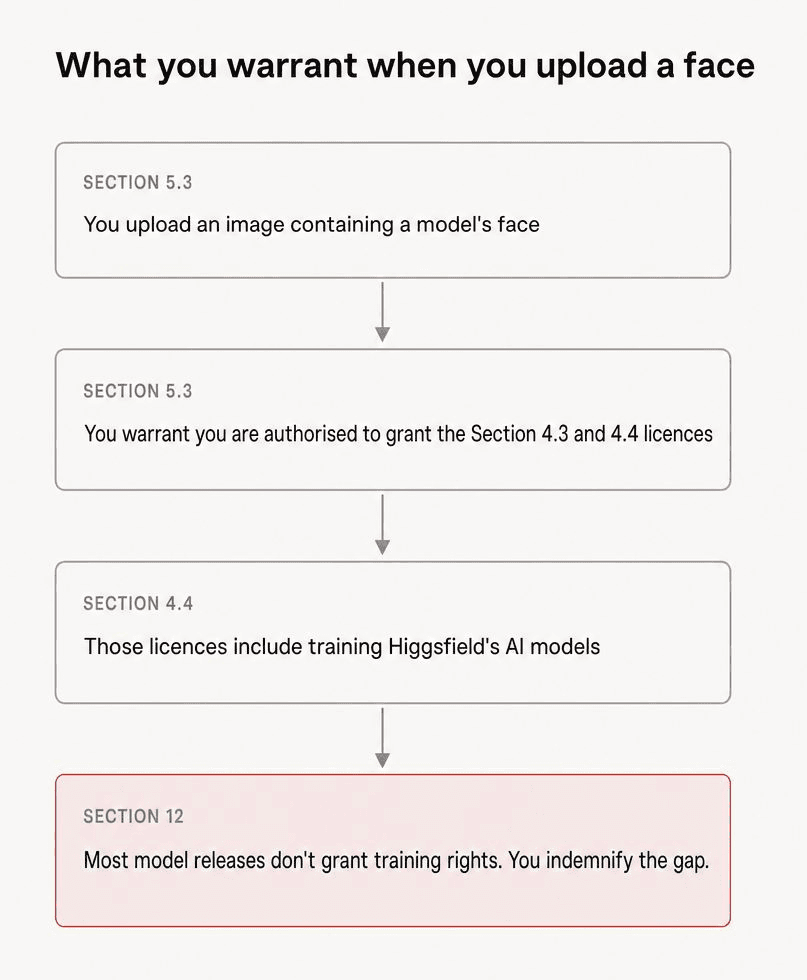
If you upload photographs or video containing a person's face, you are making three warranties. That you obtained all consents, releases, and permissions required by law from every individual whose face or voice appears. That you provided any legally required disclosures. And — this is the one — that you are "authorized to grant the licenses set forth in Sections 4.3 and 4.4 with respect to such media."
Section 4.4 is the training clause.
So read that as a chain. Upload a campaign shoot with a contracted model, and you are warranting that your model release grants Higgsfield the right to train AI models on that person's likeness.
Most model releases don't say that. Standard releases signed before 2024 contemplate print, digital, and social usage. They rarely contemplate AI training, and a growing number of newer agreements explicitly prohibit it. If your release is silent or restrictive and you upload anyway, the warranty you just made isn't backed by the rights you actually hold.
Section 12 then decides who pays for the gap. The indemnification clause was narrowed in the revision — it's now fault-based rather than unlimited, which is a real improvement — but it still covers losses arising from content you provided "without the necessary rights." That's your exposure, not the platform's.
And if it goes wrong in the other direction, Section 14.2 caps what you can recover from Higgsfield at the greater of six months of fees paid or $100.
Three more things to check
Unreleased product is the quiet one. Flat lays, samples, tech packs, and campaign concepts uploaded before a drop are, on a standard plan, training data by default. Not leaked, not published — but absorbed.
Outputs aren't exclusive. The terms state plainly that outputs may not be unique across users, that others may receive similar or identical output, and that no uniqueness, originality, or exclusivity is guaranteed. For a brand paying for a distinctive campaign look, that's a real limitation to price in.
Enterprise is the only actual opt-out. Higgsfield's own guidance says it directly: if clients require that their data never be used for training, that belongs in an enterprise agreement. On any consumer tier, the opt-out is deleting your work.
What to do before August 27
This isn't a "panic and churn" situation. It's a procurement hygiene situation, and the deadline is this week.
Find out what you've already uploaded. Especially anything pre-launch, and anything containing a real person's face. Remember the asymmetry: deleting it stops future training, not past training.
Read your model releases against Section 4.4. If a release doesn't grant AI training rights, that model's imagery shouldn't be on a training-by-default plan. This is a fifteen-minute check that prevents a genuinely bad conversation later.
Get training exclusion in writing, not in a support reply. If your agency clients require it, it belongs in a signed enterprise agreement.
Diarise the notice clause. With "reasonable advance notice" replacing 15 days, nobody is guaranteeing you a window on the next revision. Check the last-updated date on a schedule rather than waiting for an email.
Ask every vendor the same three questions. Do you train on my uploads by default? Is opting out available below enterprise? Does deletion remove my content from models already trained? Ask us the same ones.
The broader point
Higgsfield fixed the licence. Under sustained public pressure, in 72 hours, they removed language that never should have shipped — and the result is a genuinely better document than the one that caused the uproar.
They also kept the training grant intact and swapped a countable notice guarantee for an adjective, and the second of those got almost no attention because the first was easier to write about.
That's the real lesson for anyone evaluating AI visual tools in 2026. The clause that gets a viral thread and the clause that decides what happens to your brand's data are rarely the same clause. "Perpetual" is a scary word and it made headlines. "May be used by Company to train" is the sentence that survived, and it's the one that governs your catalogue.
At Caimera we take the opposite default — customer content isn't training data, and rights and indemnification are written down rather than clarified after a backlash. You can read how we handle AI rights and decide whether it holds up.
But the more useful takeaway isn't about us. It's this: read Section 4 of whatever platform your team is uploading to. Then read your model releases. If those two documents disagree, you have a problem no vendor's blog post will solve for you.
Our complete legal and ethical guide to AI fashion imagery covers the rights questions in depth, and for teams that need contractual training exclusion, talk to our team.
Sources and method
Every clause quoted above was read from the documents themselves, not from coverage. The three Terms of Use versions are permanent Internet Archive captures, so you can run the same comparison:
Primary — Higgsfield's own documents
Terms of Use, captured 22 Jul 2026 — the pre-controversy version, stamped Last Updated Date: August 30, 2025. Contains the perpetual licence and the training grant.
Terms of Use, captured 25 Jul 2026 — the version stamped Last updated: July 23, 2026, the one that triggered the backlash.
Terms of Use, captured 28 Jul 2026 — the revision stamped Last updated: July 26, 2026.
Terms of Use Agreement (live) — still Last updated: July 26, 2026 as of publication.
Privacy Policy (live) — Effective as of: August 27, 2026; Last updated: July 26, 2026. Source for the effective date, the biometric section, and the deletion/retention language.
Updates to Higgsfield's Terms of Use and Privacy Policy — Higgsfield's own announcement, published 25 Jul 2026, modified 18 Aug 2026.
Clause references
Licence grant §4.3 · training grant and marketing use §4.4 · biometric and likeness warranties §5.3 · personal information in inputs §5.4 · indemnification §12 · liability cap §14.2 · account deletion and retention §16.5 · developer change notice §11.10 · agreement updates §19.6.
What we did not verify independently
The 331,000-view figure, the attribution of the original thread to Theoretically Media, and the claim that the July 23 terms were emailed to account holders all come from third-party coverage. X blocks automated access, so we could not confirm them at source, and we have flagged them as reported rather than established. Every clause claim in this article is from the documents above.
Accurate as of 24 August 2026. Higgsfield can revise these terms at any time by updating the "Last Updated" date, and §19.6 now promises only "reasonable advance notice" — check the current version before relying on any clause here.