Higgsfield AI's X Ban: A Case Study in How Platform Trust Collapses

Prateek Gupte
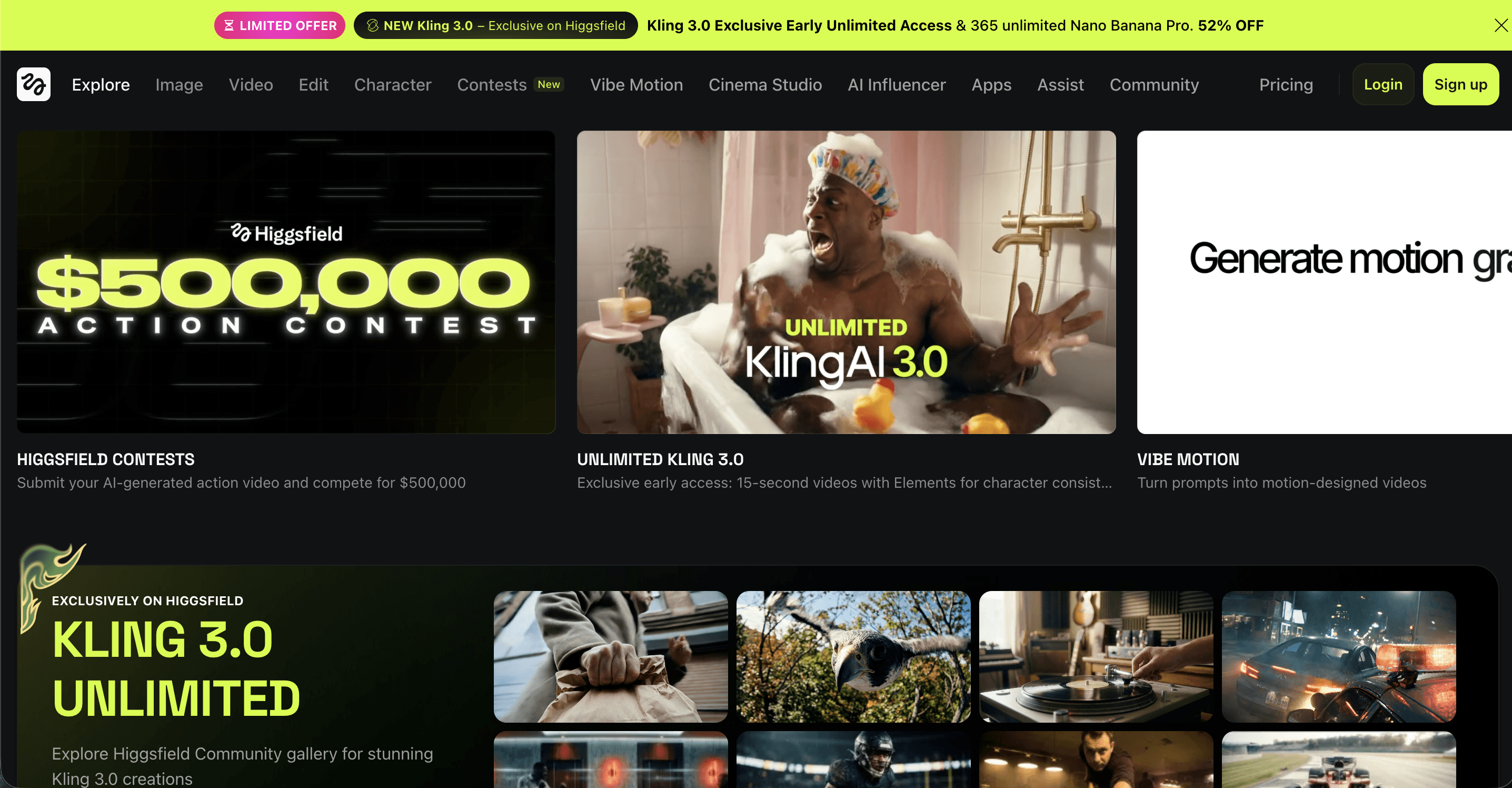
On February 9, 2026, Higgsfield AI's official X account got suspended. Just like that. No explanation from X (formerly Twitter) they rarely give one.
But what happened before that suspension tells you everything you need to know about how reputational damage builds in the AI industry.
Why This Matters for Every AI Company?
This wasn't a sudden crash. It was a chain reaction: marketing promises that outpaced what the product could actually deliver. Service issues that got hidden instead of fixed. Community trust that eroded because people felt deceived. And finally, actions that triggered X's anti-manipulation safeguards.
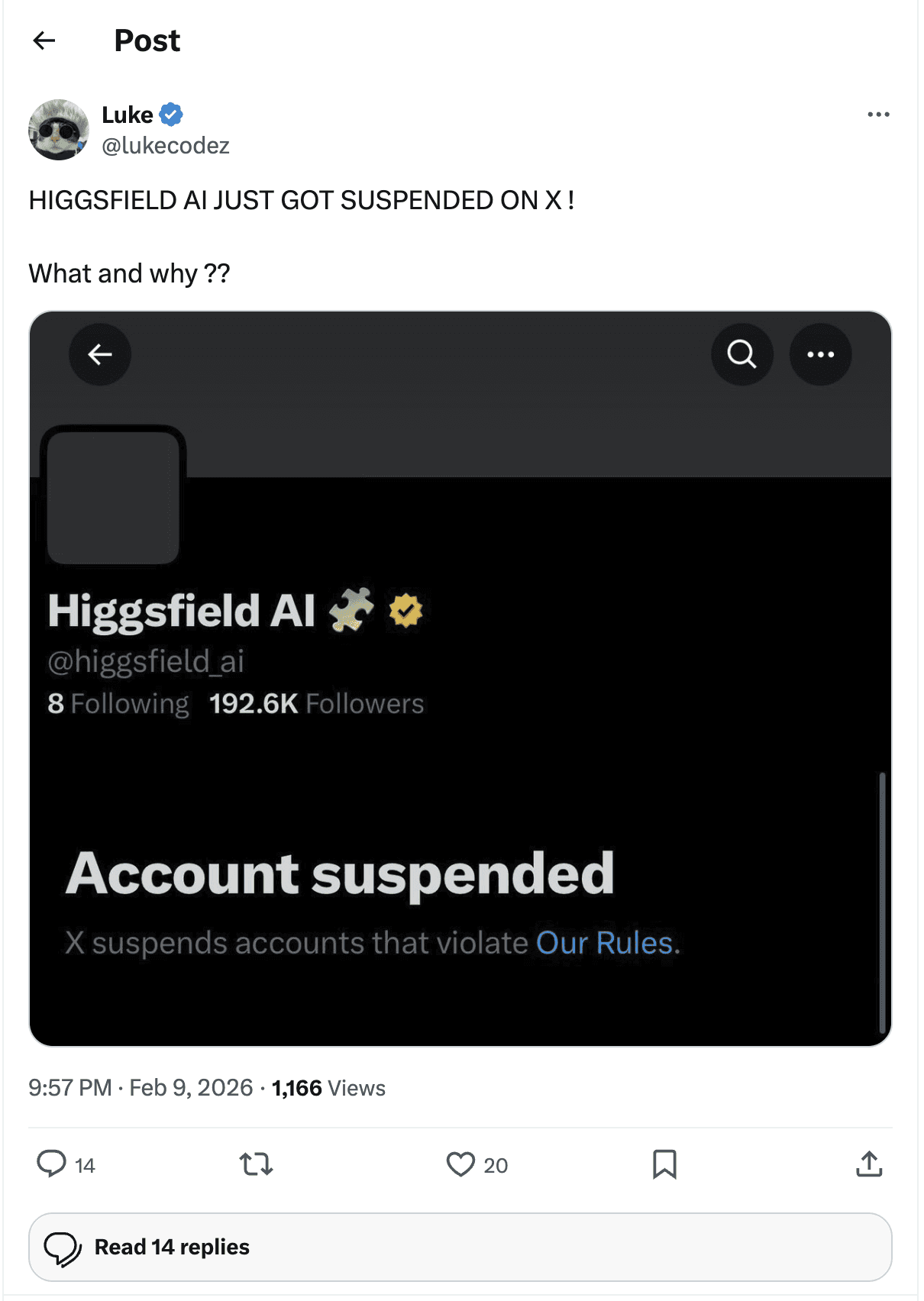
Source - https://x.com/lukecodez/status/2020897420398428255
The AI video generation space is crowded. Creators, agencies, and brands are choosing between platforms. They're betting time and money on your roadmap. When you say you'll deliver something and you don't, or worse, when they find out only after paying, the cost isn't just a refund. It's losing the entire community's trust.
This article a research-backed breakdown of what went wrong, why it went wrong, and how any team building an AI platform can avoid the same mistakes.
Gif by Tenor
What we're covering:
The specific issues that led to the X suspension
What users and the community reported (with sources)
How gaps between marketing promises and product reality compound
Concrete steps you can take right now to prevent this
What Happened
Higgsfield AI's main X account was suspended on February 9, 2026. This came about six weeks after a major crisis in late December 2025. It also came just days after renewed media coverage criticizing the company's marketing practices.
X doesn't disclose why specific accounts get suspended. And Higgsfield hasn't made a public statement either. But looking at the months leading up to the ban, you see a clear pattern: promises about features that didn't work as advertised. Mass account bans without clear communication. Attempts at damage control through influencer messaging. All of it violates X's policies on platform manipulation and spam.
Why It Happened: The Core Issues
Tenor Gif
1. "Unlimited" That Wasn't Unlimited
Here's the smoking gun: Higgsfield marketed "Unlimited Kling AI 3.0" access. But when users checked directly with Kling AI, they got this response: "There is no Kling Unlimited since Kling doesn't offer Kling unlimited."
(See 1,036+ user reviews on Trustpilot)
That's a problem. If the actual source doesn't offer it, how is a third-party reseller promising it?
What Higgsfield actually did, they put user requests in a queue. Then they added delays. Then they sent those delayed requests to the real AI service. This made it look like unlimited access. But customers got a fraction of what they'd get going directly to Kling AI or Google Veo 3 or Sora 2.
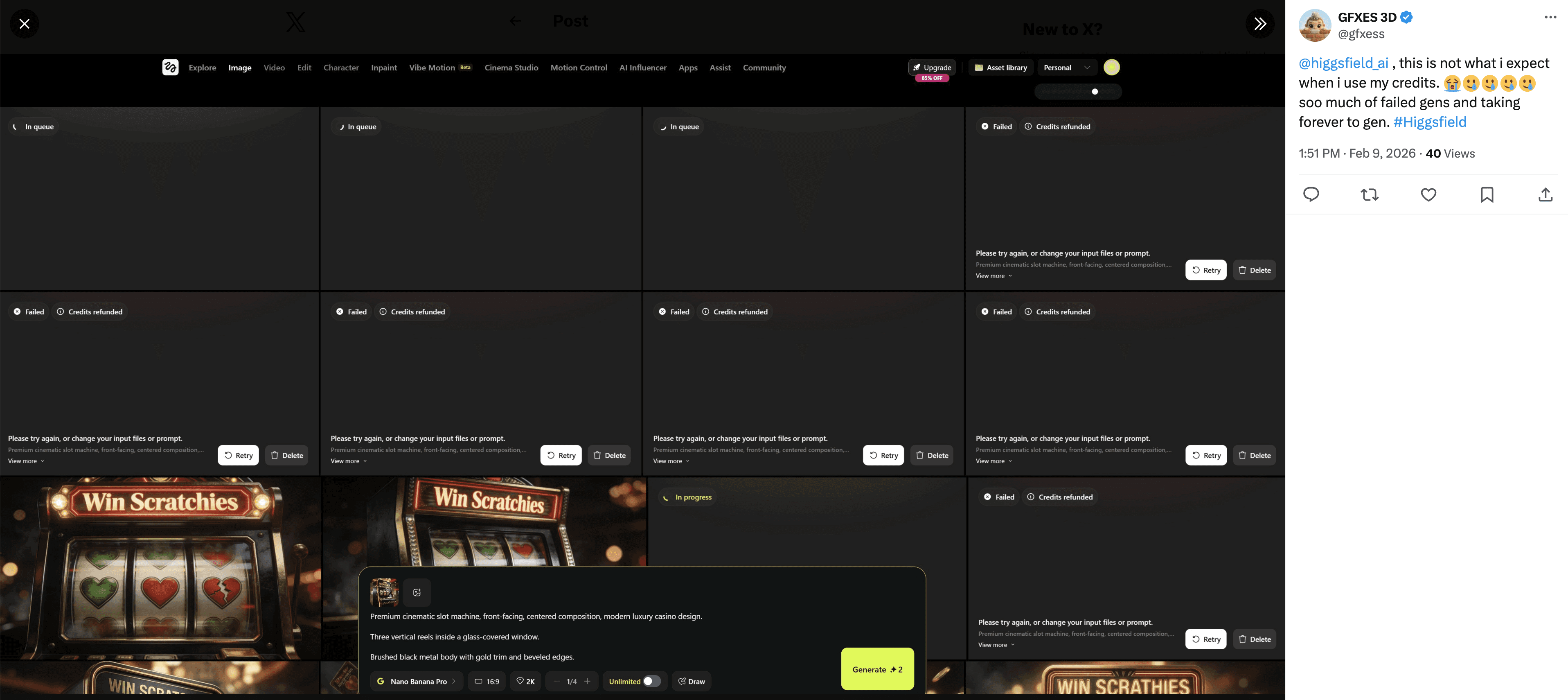
Source - https://x.com/gfxess/status/2020774934520479924
One user described it this way: "It's not unlimited. It's a quick trial of it, and the terms and conditions say if you use it a lot, we'll ban you."
Translation for your team: Don't market features from partner services without verifying they can handle the scale. If you're reselling an AI image generator or AI video generator, own your limitations from day one. How you present those constraints matters. Learn more about authentic product marketing in our guide on how brands approach AI-powered product validation.
2. The Christmas Grinch Scandal (December 2025)
In late December 2025, hundreds of users got banned from Higgsfield. Their accounts froze. Their credits disappeared.
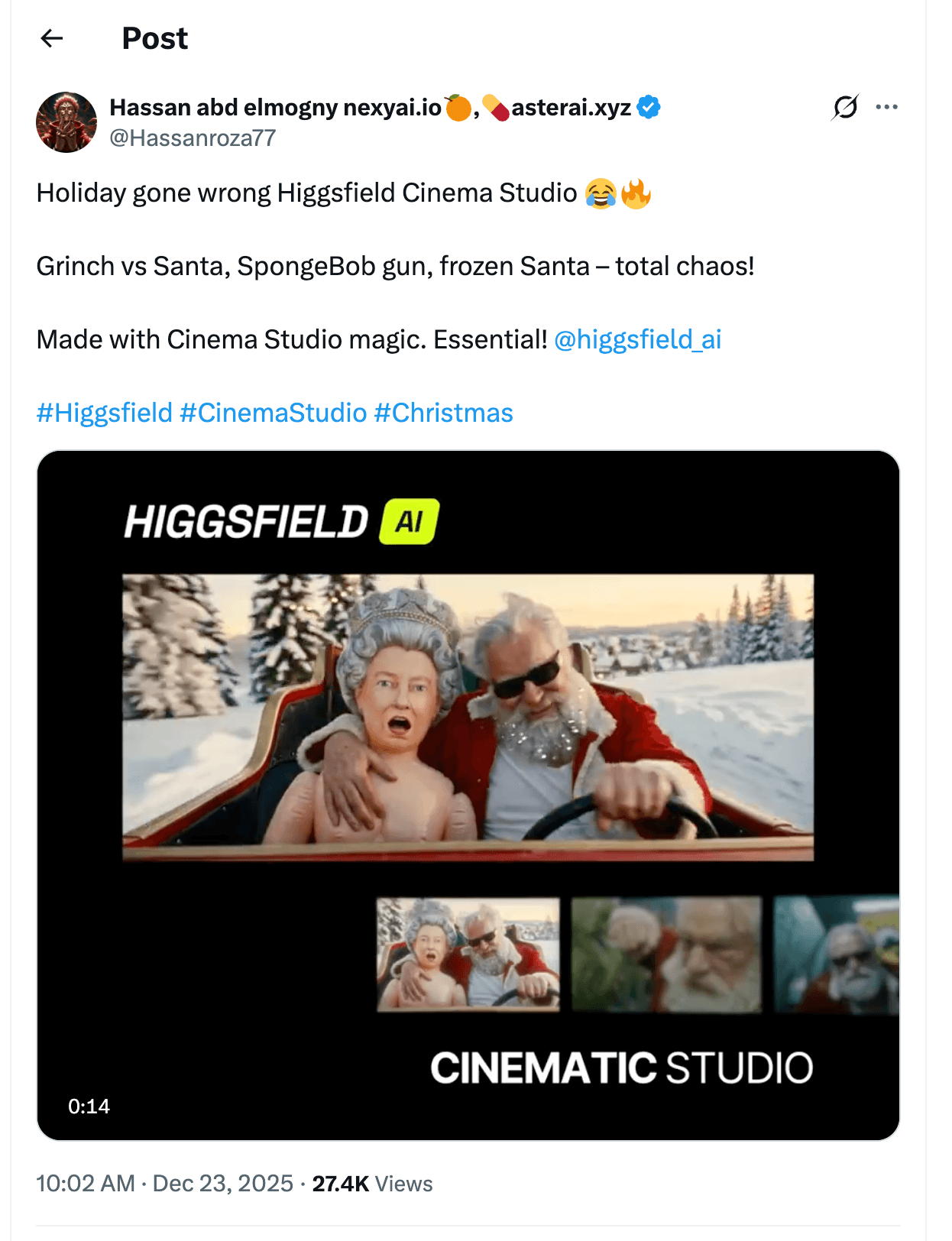
Source - https://x.com/Hassanroza77/status/2003322718880694591
Higgsfield's official story: 99% of bans were due to "fraudulent activities involving gray or black payment methods."
Sounds reasonable, right? Except it wasn't true.
Users reported getting banned on subscriptions they paid for with their own credit cards. No intermediaries. No fraud. Just a regular Visa or Mastercard.
And then Higgsfield reduced concurrent jobs on Ultimate plans from 8 to 4. No refunds. No warning.
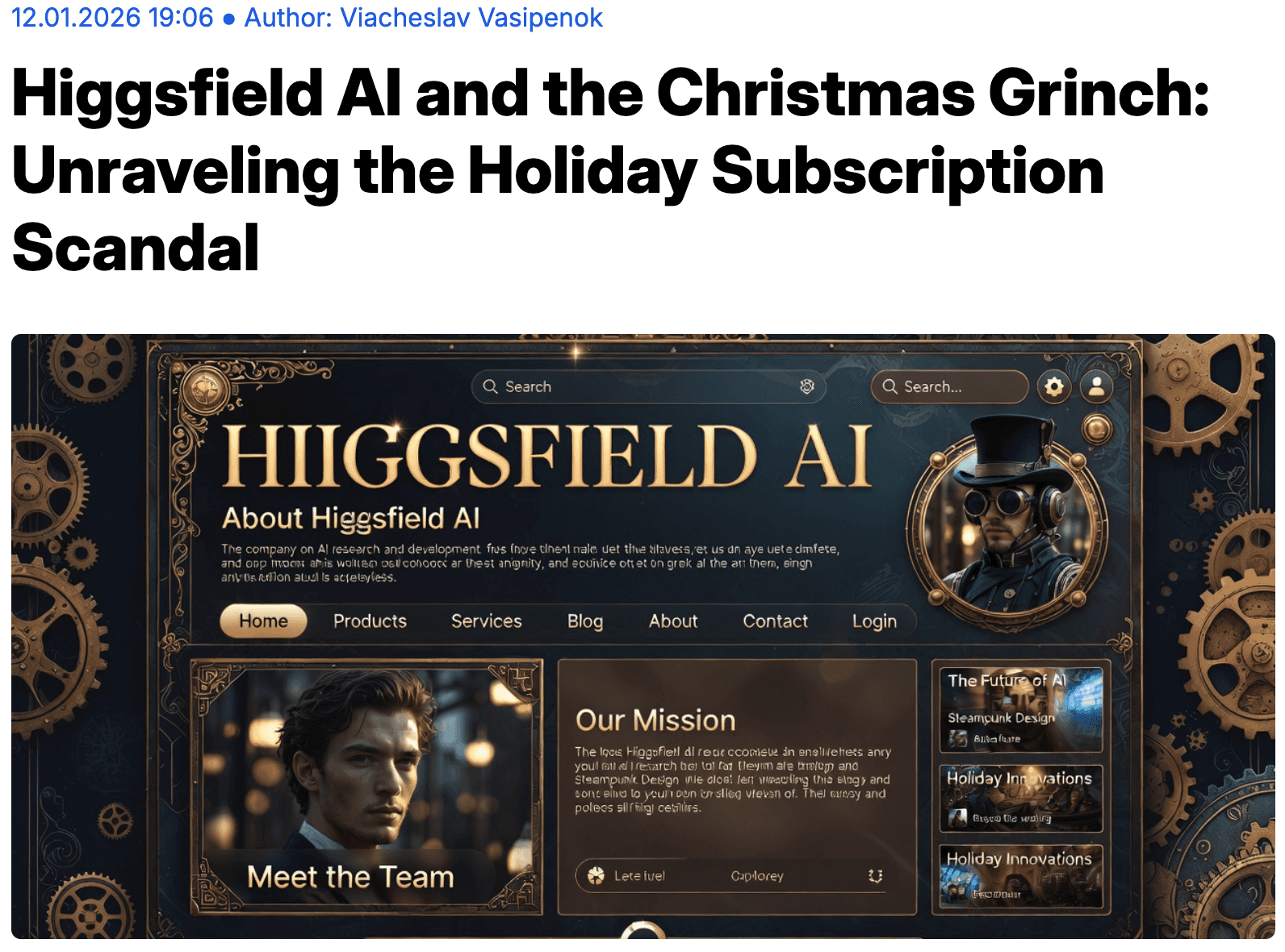
Read full story here - Higgsfield AI and the Christmas Grinch: Unraveling the Holiday Subscription Scandal
Discord threads and Reddit posts from r/HiggsfieldAI painted a picture of a targeted purge. Not isolated fraud cases. A systematic ban wave.
The really damning part? When Higgsfield quietly unbanned accounts on December 27th under public pressure, they restored the very users they'd accused of fraud. Users who supposedly committed fraud. Restored with no explanation.
That move proved the fraud story was a cover-up. Not the truth.
Translation for your team: When your product hits capacity limits, don't blame users. Don't invent fraud stories. Be transparent. The moment you ban power users, your community knows something's broken. Transparency always beats spin. This is especially critical when working with fashion brands, where trust in your AI tools directly impacts how clients invest in your platform.
3. Rage-Bait Marketing That Backfired Spectacularly
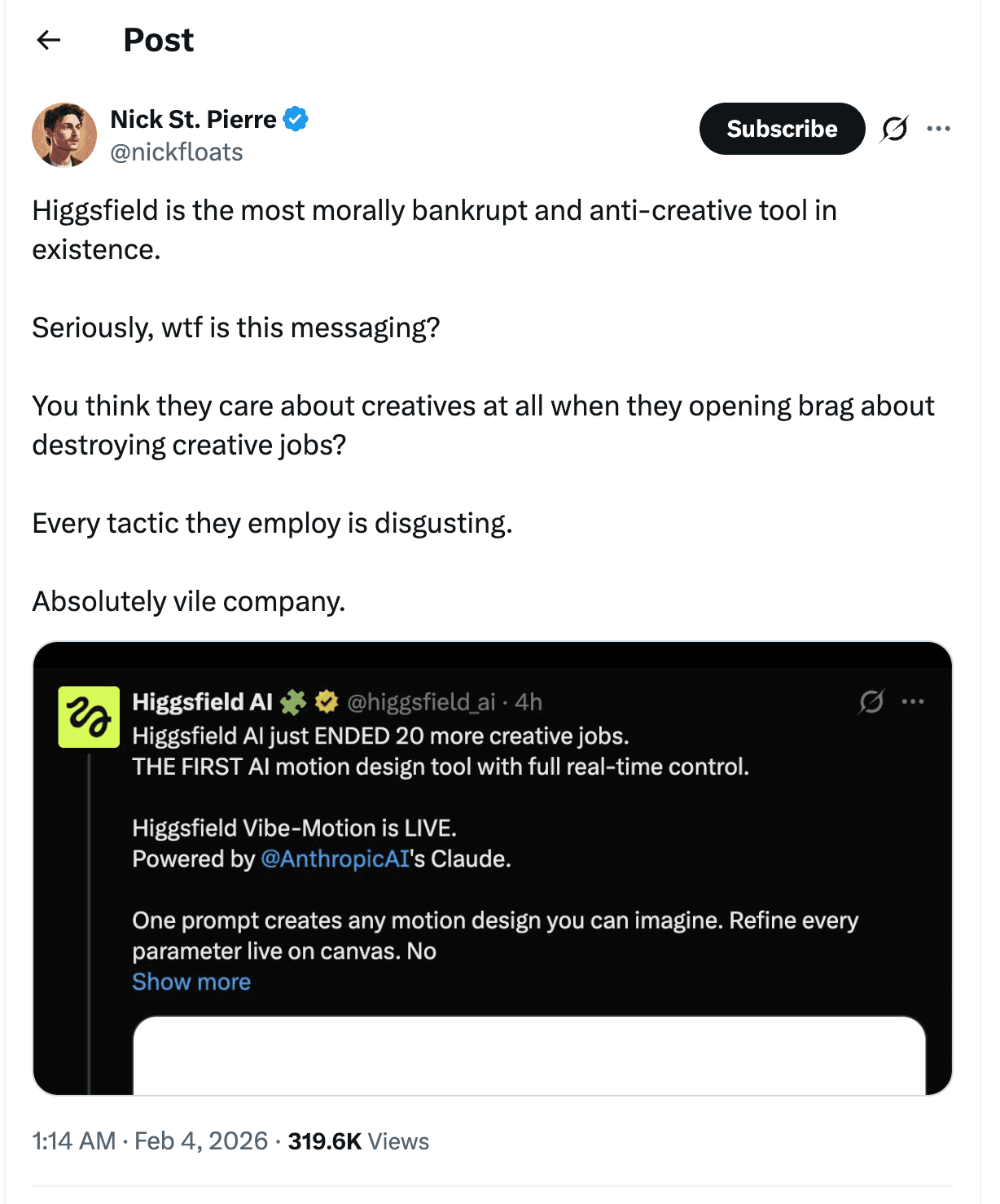
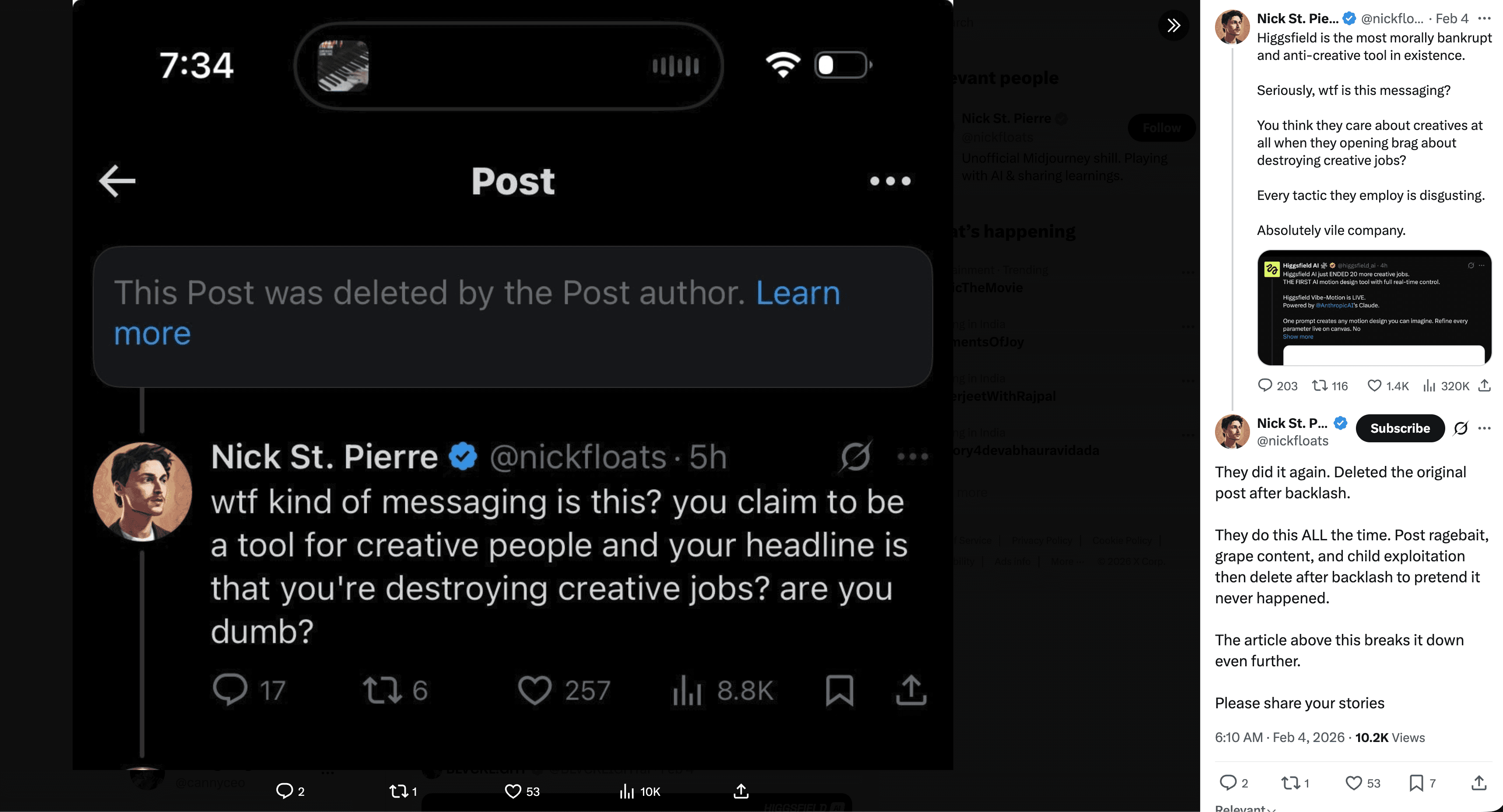
Higgsfield posted on X: "Higgsfield AI just ended 20 more creative jobs."
Source - https://x.com/nickfloats/status/2018772595991015760
Source - https://x.com/nickfloats/status/2018847151149965458/photo/2
They weren't apologizing. They were bragging.
The post celebrated replacing artists with an AI character generator. To a platform full of creators.
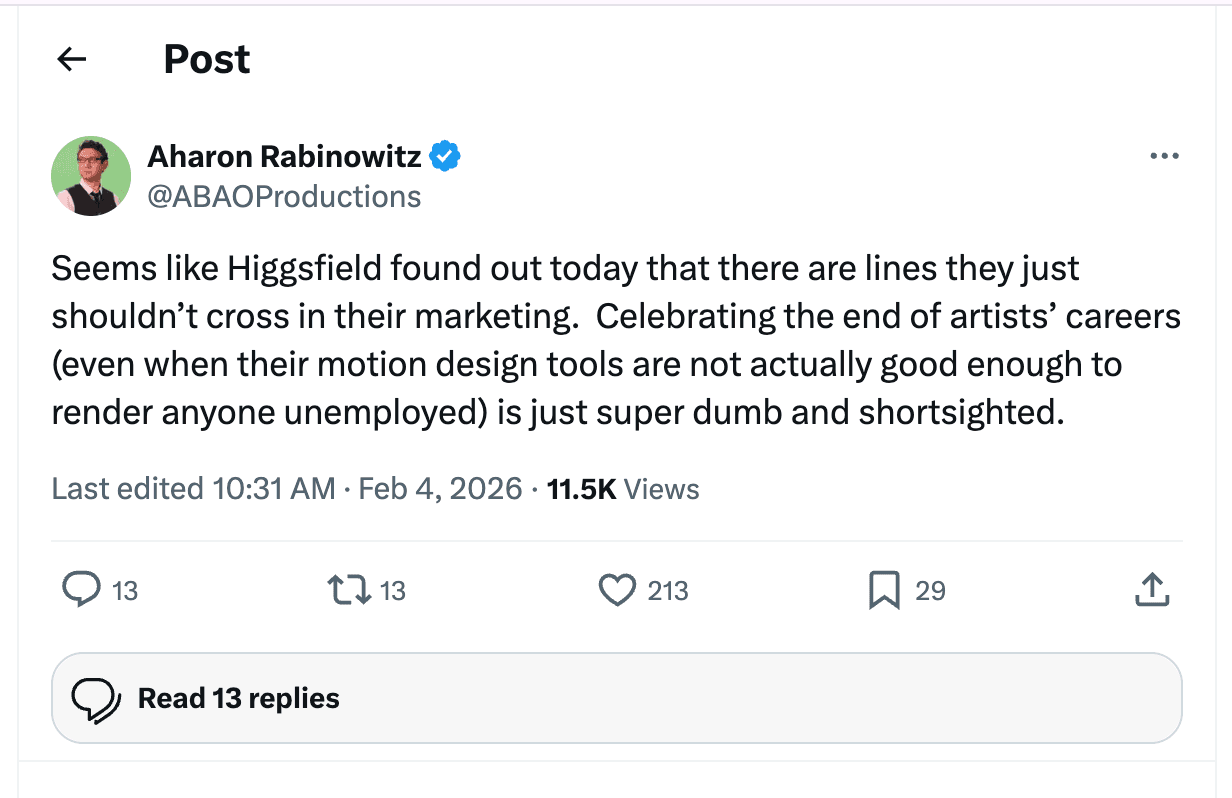
Aharon Rabinowitz, CEO of Motion Management, fired back publicly: "Seems like Higgsfield found out today that there are lines they just shouldn't cross in their marketing. Celebrating the end of artists' careers is just super dumb and shortsighted."
Source - https://x.com/ABAOProductions/status/2018912789767565681
Another creator called it out directly: Higgsfield's "engagement-bait marketing strategy" was "childish and unprofessional." as reported by The Register publication
The company faced accusations of bait-and-switch tactics. Undisclosed review astroturfing. Predatory billing. Deceptive marketing across the board.
Translation for your team: Your creator community isn't your marketing audience. They're your customer base. Don't celebrate harm to them for engagement metrics. Ever. When AI tools directly affect how creators and fashion brands work, respect that ecosystem.
4. Mass Reports + Coordinated Influencer Messaging
X doesn't say exactly why accounts get suspended. But the pattern here is clear.
After articles came out criticizing Higgsfield, the company started DMing influencers with damage control messages. Here's what they said:
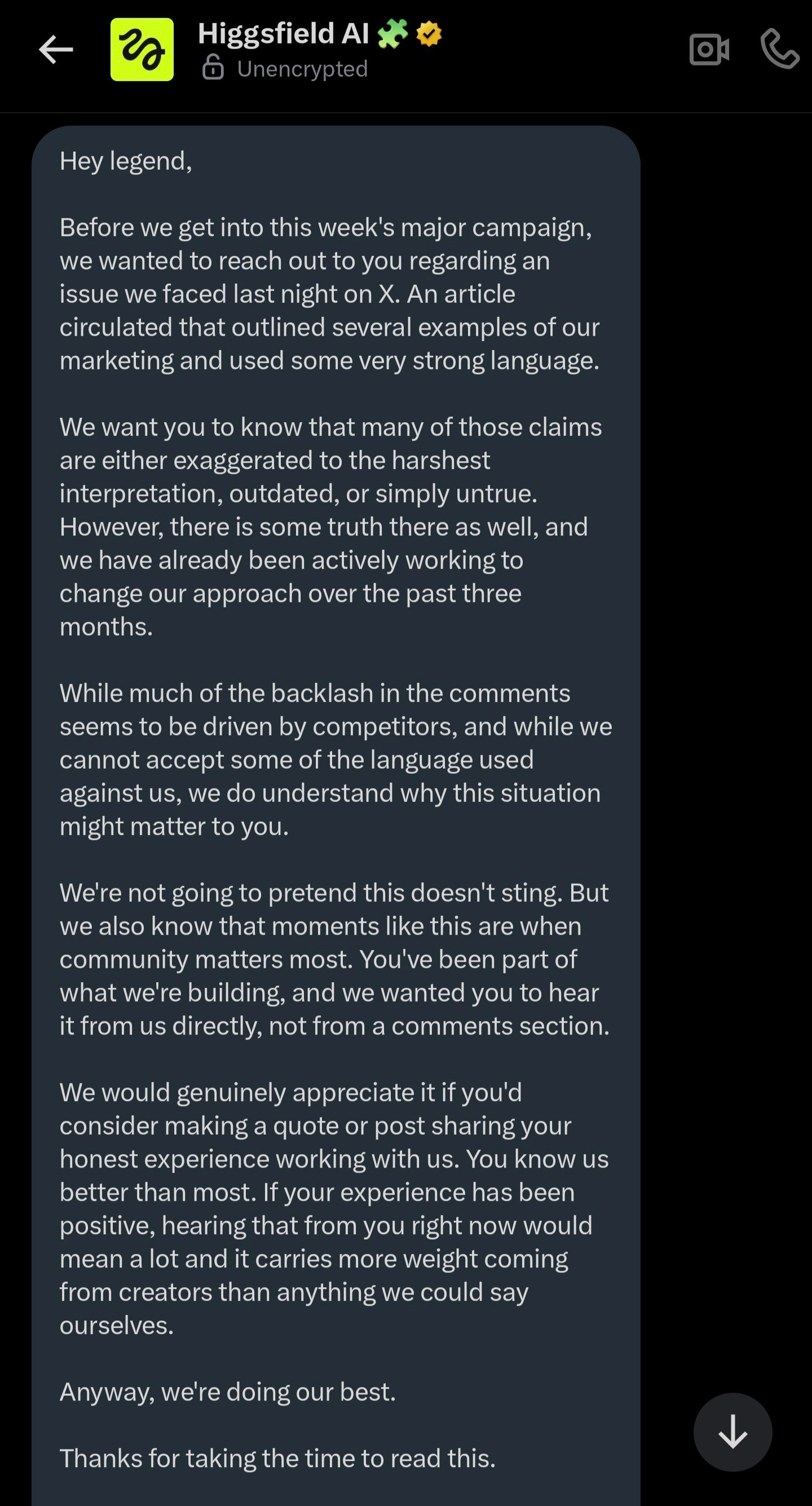
Source - https://github.com/Anil-matcha/higgsfield-ai-scam/blob/main/images/dm.jpg
"An article circulated that outlined several examples of our marketing and used some strong language. We want you to know that many of those claims are either exaggerated to the harshest interpretation, outdated, or simply untrue. However, there is some truth there as well."
That's not defending. That's admitting the criticism was valid while asking creators to help spin it.
They also asked creators for positive testimonials. Quotes they could use publicly. Because creator testimonials carry more weight than company statements.
This pattern, coordinated influencer messaging after criticism, astroturfing recovery attempts, triggers X's anti-manipulation protocols. It's the kind of coordinated inauthentic behavior platforms are specifically designed to catch and penalize.
5. The Contest and Influencer Promotion Strategy
Higgsfield launched a $500k contest. They also started paying influencers to promote it.
Some influencers got direct messages offering $200 per quote tweet. The campaign ran from February 3-6.
One influencer publicly called it out: "Higgsfield AI is buying fake hype. Undisclosed ads make X worse and undermine trust."
This violates FTC guidelines on undisclosed sponsorships. It also violates X's policies on paid amplification without disclosure.
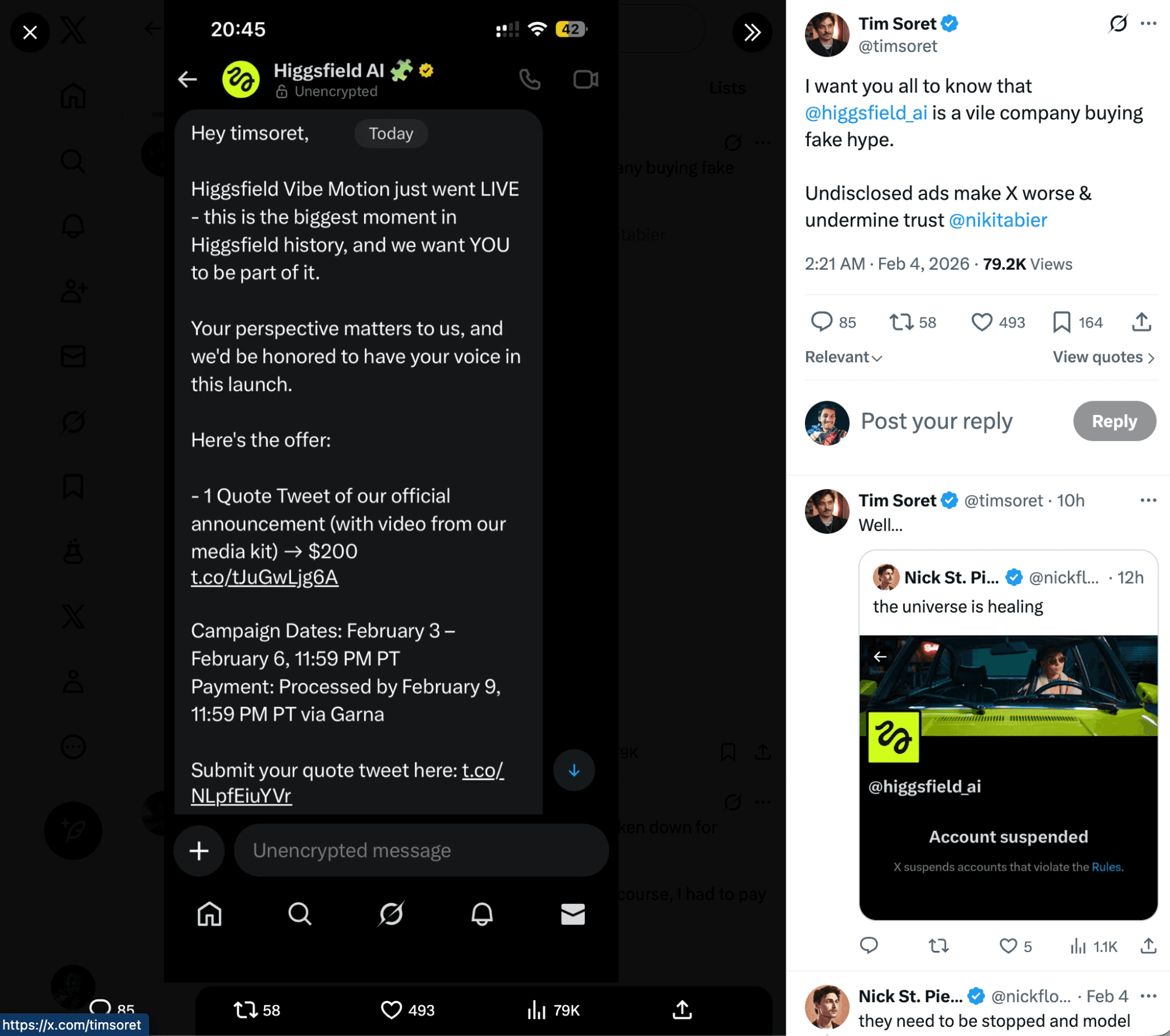
Source - https://x.com/timsoret/status/2018789374893375650
Timing matters too. This all happened after the job-loss backlash. After the expose articles. It looked like Higgsfield was trying to bury the negative stories with paid promotion.
Translation for your team: If you're running influencer campaigns, disclose them. Always. The FTC requires it. X requires it. Your audience expects it. Shortcuts here destroy credibility faster than anything else.
What Users Actually Reported
Across 1,036+ Trustpilot reviews, Discord channels, Reddit communities, and GitHub repositories, the complaints are consistent and damning:
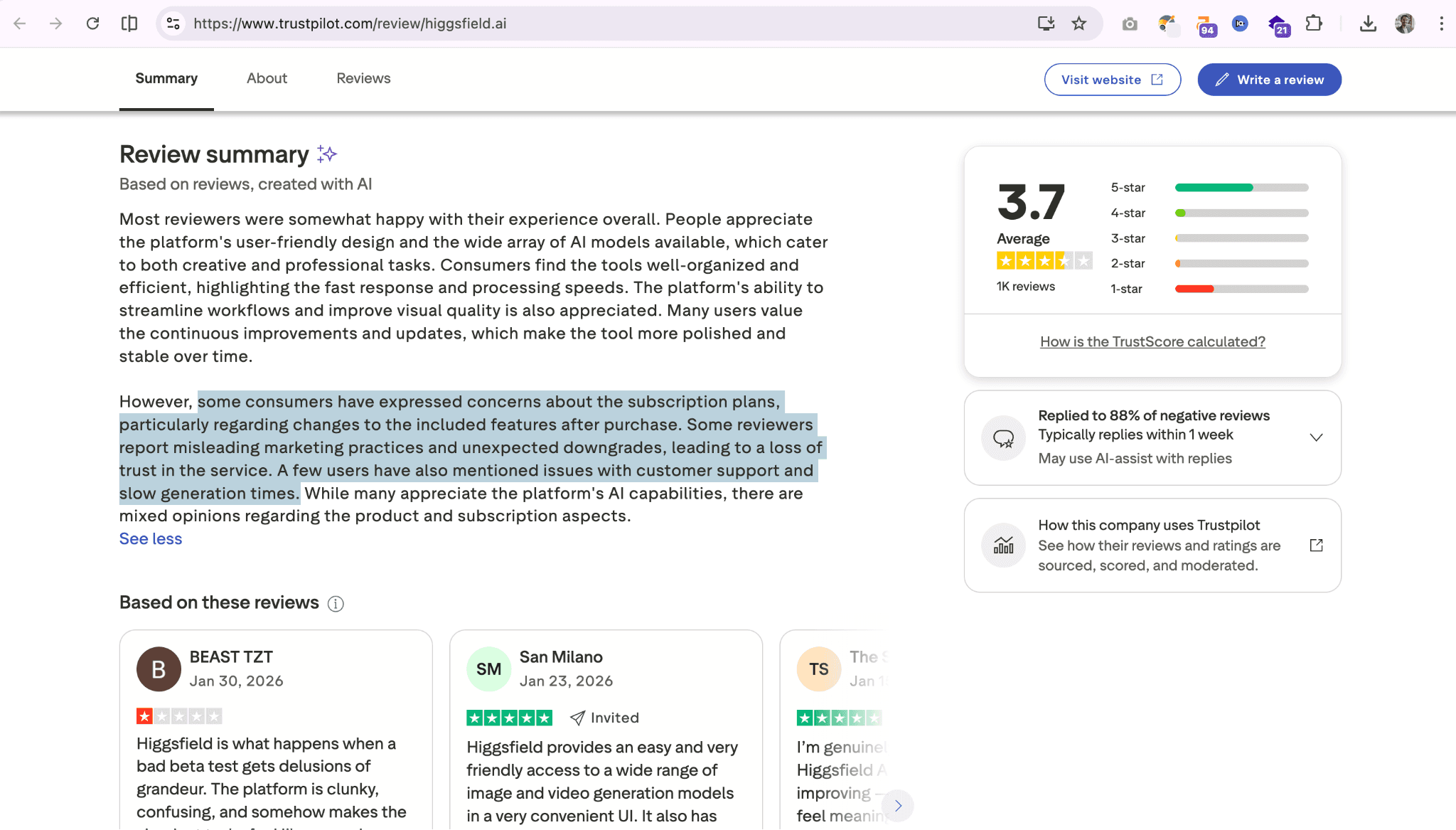
Source - https://www.trustpilot.com/review/higgsfield.ai
Refund Policy That Doesn't Work
Trustpilot reviews detail the same complaint over and over: refunds only available if you haven't used any credits. This means you can't actually test the service without losing your refund rights.
One user put it simply: "How can I know if it works if I can't use it?"
This is the opposite of customer-first thinking. When you're building AI tools for fashion brands and creative professionals, a refund policy should signal: "We stand behind what we built." Not: "We'll lock you in if you try to use it."
Data Rights Issues
The Terms of Use grant Higgsfield a "perpetual, irrevocable, worldwide license" to use your prompts and generated outputs. Not just for model training. For marketing materials too. With rights transferable to third parties.
Creators who value their work called this out immediately. Your content could appear in ads without compensation.
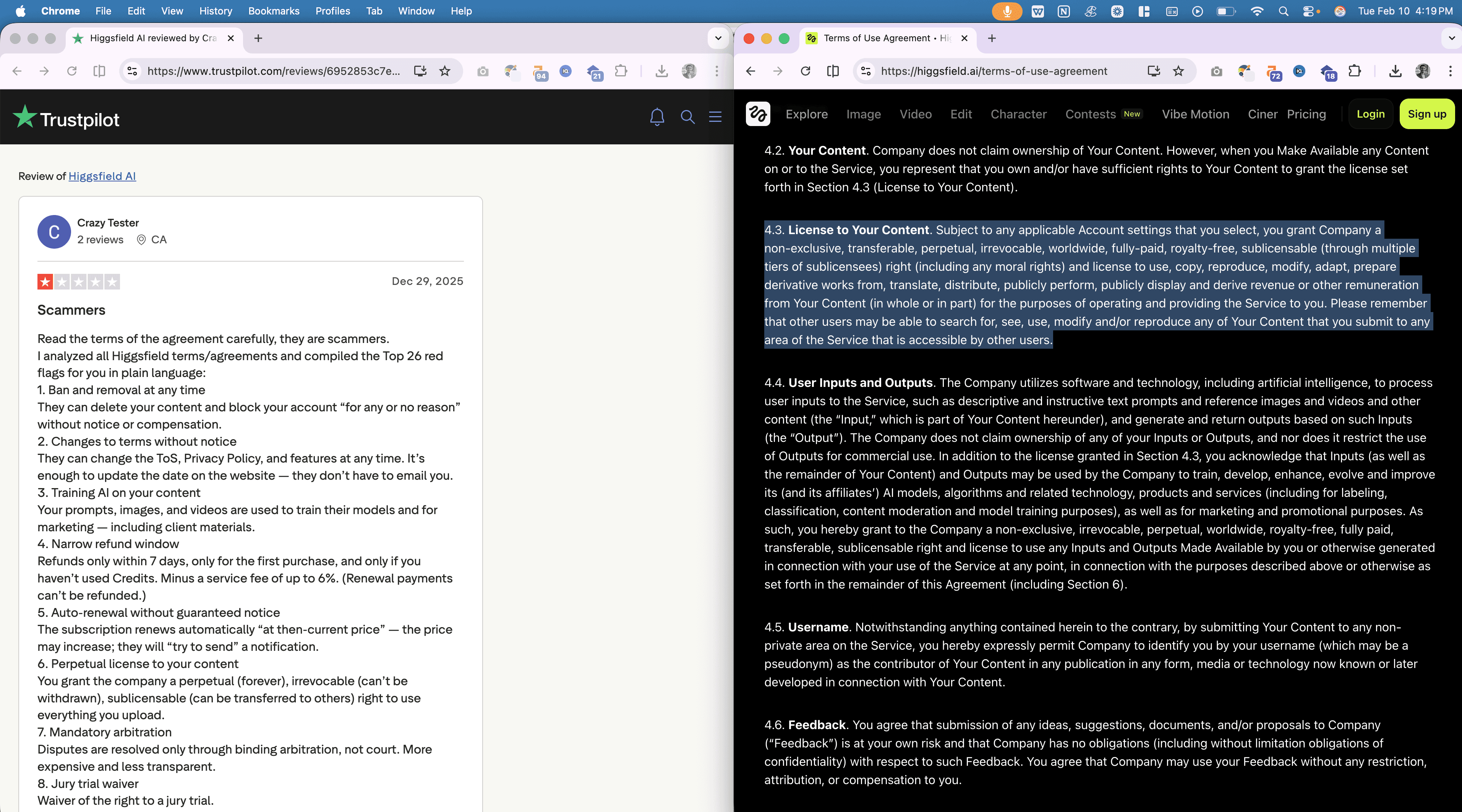
Source
- https://www.trustpilot.com/reviews/6952853c7eda14a0e29548c4
- https://higgsfield.ai/terms-of-use-agreement
This is critical for fashion agencies and brands. When you generate lookbooks or product photography using AI tools, you need to know exactly who owns that content and how it can be used.
Speed Promises vs. Reality
Marketing said fast results. Users reported 4-10 hour wait times for five-minute videos.
One user wrote: "Either something's unlimited or it's not. It turns out it's not. Really you're not getting anything unlimited. You're getting a quick trial and then a queue system that delays results for so long you get a fraction of what you could get going directly to the service."
(Investigation report: https://www.theregister.com/2026/02/06/higgsfield_ai_job_loss/)
Stock Templates Passed Off as AI Output
Investigation revealed Higgsfield used pre-made templates from Envato Elements and Jitter.video. They presented these as AI-generated features.
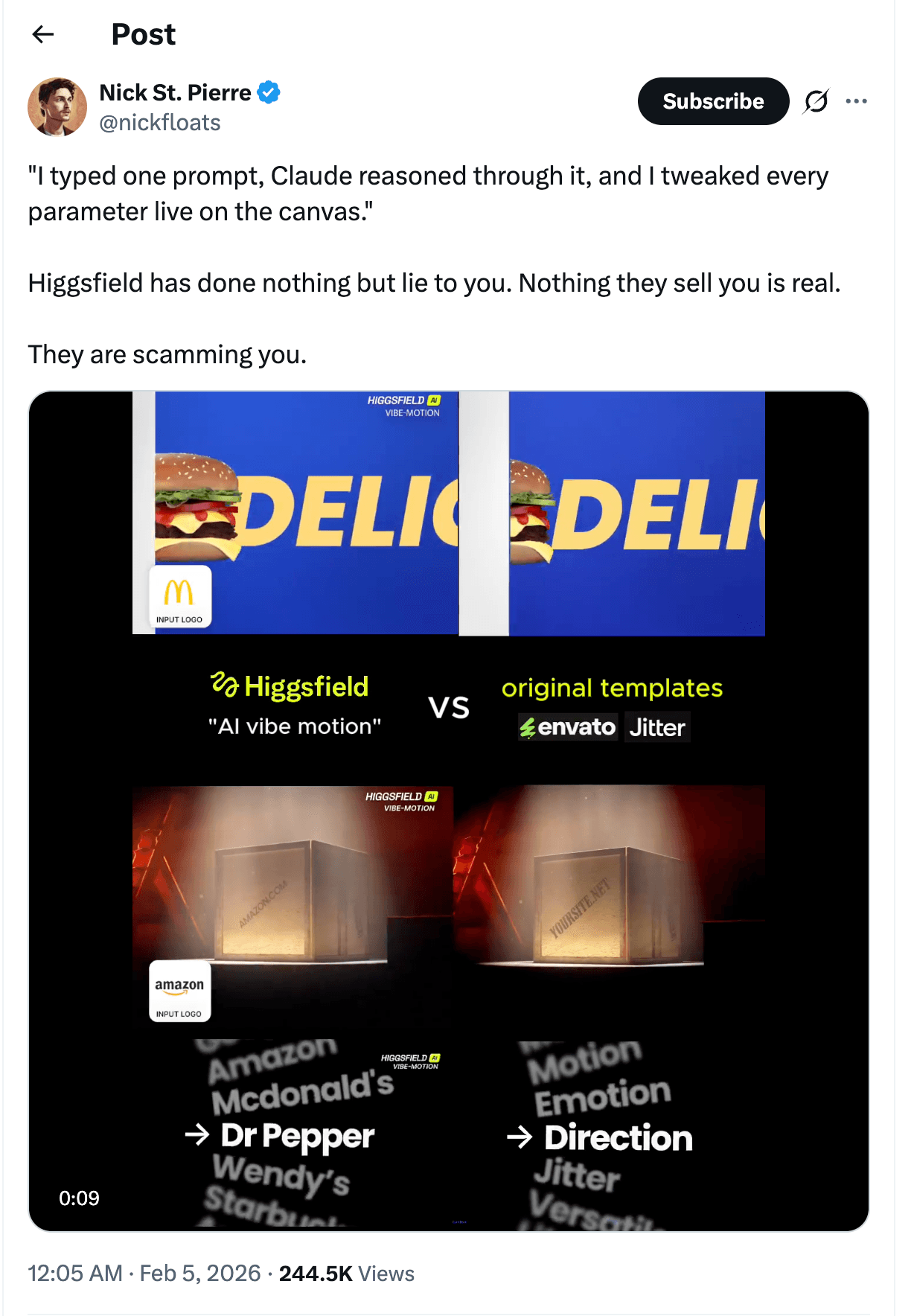
Source - https://x.com/nickfloats/status/2019117588089876616
It's one thing to use motion design templates. It's another to claim they're outputs from your proprietary AI technology. This crosses into misleading customers about what they're actually paying for.
(Technical breakdown: https://github.com/Anil-matcha/higgsfield-ai-scam)
How This Happens: The Structural Problem
Three teams. Three different realities.
Marketing sets expectations. "Unlimited access. Fast results. No restrictions." They need to hit growth targets.
Product builds the features. But they can't match the scale implied by marketing. They hit capacity constraints. They implement throttling.
Operations face the pressure. Customer support is flooded with complaints. Account management recommends bans to reduce server load.
The gap widens. Each team works in isolation. By the time anyone talks across departments, it's too late. The community has already figured out the truth.
This dynamic destroys companies. It doesn't matter if your product is technically good. If marketing promises don't align with what product can deliver, you're building a reputation debt that compounds daily.
How to Avoid This Trap: Six Concrete Steps
1. Separate Marketing from Product Roadmap (Rigorous Alignment)
Before any feature claim hits marketing channels, the product needs to certify it.
Questions to ask:
Can we sustain this at scale?
What happens if adoption explodes tomorrow?
Where's the throttle point? Are we transparent about it?
Get this in writing. Have marketing and product sign off together on every feature claim. Include a "break-in-case-of-emergency" escalation path for when reality diverges from the narrative.
This isn't bureaucracy. This is survival. One misaligned claim about an AI image generator or AI video generator or face swap AI can tank your entire reputation.
For fashion brands and agencies using these tools, this alignment is the difference between a platform they trust and one they advise their peers to avoid.
2. Refund Policy = Trust Signal, Not a Lock
Higgsfield's "refunds only if unused" tells customers: "We don't stand behind this product."
A 30-day money-back guarantee costs money upfront. It saves reputation damage later.
With AI output quality, subjectivity is built in. Own that. Don't try to design refund policies that trap customers.
When customers trust you'll take care of them, they're more patient with iterations. They become advocates instead of critics. They recommend you to other brands in their network.
This is especially true for fashion brands and marketing agencies evaluating AI tools for their production workflows. A transparent refund policy says: "We're confident in what we built."
3. Monitor Your Own Community Weekly
Higgsfield didn't catch the problem until it was public.
Assign someone to scan these weekly:
Discord/community channels (search: "banned," "refund," "misleading," "slow," "throttle")
Trustpilot, G2, Capterra reviews
Reddit threads mentioning your company
X mentions (run sentiment analysis)
If 10+ complaints surface in one month, that's a red flag. Respond with honesty. Not PR.
Early detection saves everything. Late detection saves nothing.
This isn't just defensive work. It's market research. Your community is telling you what matters to them. Listen. Respond. Fix it.
4. Creator Partnerships Aren't Marketing Ammunition
After the backlash, Higgsfield DMed influencers asking for positive testimonials. That's tone-deaf. Your community sees it as desperation.
When you partner with creators:
Genuine feedback? Say: "We'd love an honest review, even if it's critical."
Sponsorship? Pay fairly and disclose it clearly.
Testimonial? Only ask if they genuinely use and love the product.
Authentic creator endorsements beat paid testimonials every single time.
For fashion brands and agencies, this means: partner with creators who actually use your tools in production. Let them tell their story. That story, how your platform helped them save time, reduce costs, or unlock new creative possibilities, is worth more than any headline.
5. Own Your Speed Claims (Or Don't Make Them)
Higgsfield promised fast results. They delivered delays that made the service unusable.
Be specific about what you can actually deliver:
"Most AI image generations under 2 minutes"
"95% of AI video jobs complete within 24 hours"
"Peak hours may see longer queues; upgrade for priority access"
If you can't guarantee speed, don't market speed. If you're scaling gradually, version your claims as you grow. Customers respect honesty about constraints more than they accept false promises.
This matters for fashion brands running time-sensitive campaigns. If you say something will be ready by tomorrow, it needs to be ready tomorrow.
6. Data Rights Must Be Negotiated, Not Assumed
When Higgsfield's terms claimed perpetual, irrevocable rights to user content - including for marketing purposes, creators lost faith immediately.
Be explicit from day one:
Is customer content used for training? Disclose it. Let customers opt out.
Who owns the generated content? Be crystal clear.
What happens to data after the contract ends? Document it.
Are third parties getting access? Say so upfront.
Transparency here is a competitive advantage. Secrecy is liability.
For brands and agencies creating lookbooks, product photography, and campaign content using AI tools, data ownership is non-negotiable. You need to own what you create.
The X Ban Was a Symptom, Not the Disease
The suspension didn't happen randomly. It was the result of:
Broken promises (unlimited access that wasn't unlimited)
Opaque actions (mass bans without clear communication)
Tone-deaf marketing (celebrating job loss to creators)
Narrative collapse (exposed by users, then clumsy damage control)
X's enforcement was a reflection of community reports and policy violations. The real damage happened earlier. In the community. When trust broke.
What X suspension actually meant: We don't trust you anymore.
Once you lose that, getting it back is nearly impossible.
Key Takeaway for Product & Marketing Teams
The companies that survive in AI aren't the ones with the best marketing. They're the ones where marketing aligns with what product can actually deliver.
They talk to each other before going public. They respond to problems with transparency instead of rhetoric. They respect their community enough not to celebrate harm to them.
Higgsfield had a good product. They had a multi-model hub. Creator-friendly tools. But they lost trust because marketing ran ahead of capacity. They hid problems behind stories instead of fixing them. They forgot who their customer base actually was before celebrating harm to creators.
That's a lesson every AI company needs to learn.
The stakes are high in this space. You're asking creators, agencies, and fashion brands to bet their workflows on your platform. That's trust. Protect it like your business depends on it.
Because it does.
References & Further Reading
The Register published an in-depth analysis of Higgsfield's problematic marketing tactics: https://www.theregister.com/2026/02/06/higgsfield_ai_job_loss/
Quasa.io documented the Christmas Grinch scandal in detail: https://quasa.io/media/higgsfield-ai-and-the-christmas-grinch-unraveling-the-holiday-subscription-scandal
GitHub user Anil-matcha compiled a comprehensive expose of issues: https://github.com/Anil-matcha/higgsfield-ai-scam
Trustpilot has over 1,036 user reviews documenting service issues: https://www.trustpilot.com/review/higgsfield.ai
Tim Soret exposed undisclosed influencer sponsorship campaigns on X: https://x.com/timsoret/status/2018789374893375650
Aharon Rabinowitz, CEO of Motion Management, responded to the job-loss marketing on X: https://x.com/ABAOProductions/status/2018912789767565681
Note: This article references multiple AI video generation platforms (Kling AI, Sora 2, Google Veo 3, Nano Banana Pro) and AI image generators. The principles discussed apply across all generative AI platforms competing in this space, especially those serving ecommerce brands, fashion brands, creative agencies, and content creators.
Related Reading: How Fashion Brands Are Using AI Responsibly
Explore how fashion brands are using AI authentically and ethically:
Discover how AI is revolutionizing fashion lookbooks and photography in our guide to AI-powered lookbooks: https://www.caimera.ai/blogs/guide-to-ai-lookbooks-how-ai-is-revolutionizing-fashion-photography
Learn how brands validate AI-generated product concepts before committing to production: https://www.caimera.ai/blogs/from-concept-to-launch-how-ai-revolutionizing-product-validation-in-fashion
Read about how fashion brands design and sample products using AI tools ethically: https://www.caimera.ai/blogs/how-do-brands-design-and-sample-products-using-ai
Understand the role of male models and diverse representation in AI-powered fashion content: https://www.caimera.ai/blogs/male-models-ai-fashion
Get insights on leveraging authentic brand marketing without gimmicks or manipulation: https://www.caimera.ai/blogs/valentines-day-sales-without-guide-authentic-seasonal-marketing
Explore how to leverage fashion events for authentic brand marketing: https://www.caimera.ai/blogs/leveraging-fashion-events-for-brand-marketing-in-2026
Learn the fundamentals of creating comprehensive tech packs: https://www.caimera.ai/blogs/the-ultimate-guide-to-tech-packs-in-fashion